my version of transparent, collaborative leadership...with a Teamann twist

  • About
  • Speaking & Consulting
  • Books
  • Hear & See

An #ASCD opportunity!

October 23, 2014 by Amber Leave a Comment

FY15-PDIs-590x120Flipping PD for educators allows them to do much of their own learning at home, at their own pace, and improves the time spent together in a large group. During the ASCD Educator Effectiveness Institute, Engaged and Inspired: High-Impact Strategies to Motivate and Challenge Each Learner, attendees will take part in both online and on-site learning.

Three weeks before the on-site meeting, participants will join an online learning community on ASCD EDge. Led by ASCD faculty member Stefani Hite, attendees will discuss student motivation theory based on the September 2014 edition of Educational Leadership, “Motivation Matters,” which includes important motivation topics such as choice, rigor, curiosity, relevance, feedback and relationships. At their own pace, participants will read articles from the EL issue that will frame their on-site professional development.

Next, participants will meet for one day on-site with Hite to explore what motivates students. Once on-site, participants will dive deep into student engagement and participation strategies that enhance cognitive, social, emotional, and behavioral engagement. Attendees will identity four strategies and set goals as to how they will use them in their classrooms.

Finally, the virtual learning community will reconvene for coaching and collaboration with other participants and Hite. Participants will discuss the strategies that they have implemented in their school or classroom and share what has worked and what has been challenging. Participants can exchange feedback and ideas and Hite will also answer questions and offer expert advice for four to six weeks after the on-site meeting.

This is a great opportunity for educators to not only take part in flipped professional learning, but also address one of the most important factors contributing to student achievement.

You can find all details, locations, and dates here: http://www.ascd.org/professional-development/institutes/engaged-and-inspired.aspx


Happy learning!
Amber
 

Filed Under: Conferences, Staff Development, Uncategorized Tagged With: #ASCD, #edchat

5 things learned from “Read, Write, Lead” & win your own copy!

September 14, 2014 by Amber 4 Comments

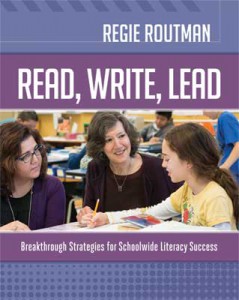
Regie Routman’s newest ASCD book, “Read, Write, Lead: Breakthrough Strategies for Schoolwide Literacy Success” was a cover to cover read for me. Knowing how well-respected Ms. Routman is certainly made me WANT to read this book, but the focus on literacy skills made it impossible to put down.

My top five take aways:113016b

1. Establish a culture of trust. A level of professional trust is crucial for effective change. (In the same way the instructional leader needs to have a relationship with their staff in order to provide coaching support, a teacher must do the same with their students.) Where trust is missing, fear is often present, and fear is a guaranteed antidote to learning. The change when moving your campus/classroom to a literacy/writing based classroom will be different from what you are used too…keep those high expectations and keep moving forward.

2. Teach with urgency. Lacking the belief that we can positively influence the learning and achievement of ALL of our students will hold us back. Teach with a sense of relevancy and purpose & connect meaning to the tasks at hands.

3. These big ideas: modeled writing from instructors, student input, authentic book discussions, connect reading & writing. I’m going to look for strong teachers to help make these happen this year. Routman writes “We need to focus our reading and writing where our students’ interests are”. In an educational system where “student engagement” is crucial, there are quick wins shared that are practical and easy to implement, from kinder to high school.

4. The entire chapter on leadership priorities. “Effective leadership is essential for excellent school wide reading and writing practice across the curriculum”…and she cites a 6 year study that not one single successful school was able to be that way “with the absence of talented leadership”. The chapter highlights significant behaviors and actions of effective leaders, which led to accelerated achievement for both students and teachers.

5. Finally, the idea of PLCs: “professional literacy communities”…I don’t think there is too big a reach from the PLCs that we see working on campuses today to one with a literacy instructional  focus. Allowing data to guide not dictate. Recognize  that there is a difference between professional development and professional learning. Identify crucial questions that can be a school focus..and make sure you stay on track.

The appendix provides instructional look-fors that are also an incredible resource.

Want to get a copy for yourself?? You can order it here or you can also enter below to get a FREE copy! Enter between today (9/14/2014) and next Sunday, (9/21/2014) and I will send the winner their copy! (I’ll be keeping mine with all the high lighting, ;))

[gravityform id=”5″ name=”Read, Write, Lead”]


read on,
Amber


Filed Under: Classroom Connections, Freebies, Reading, Staff Development Tagged With: #ASCD, #cpchat, #edchat, #teachers

An @ASCD review…Learning in the Fast Lane #ASCD

August 19, 2014 by Amber 2 Comments

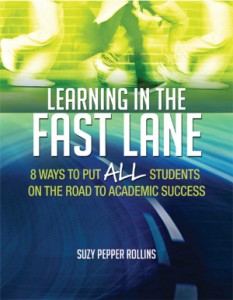
114026bIn a book that promises to lay out a plan that helps teachers close gaps in small group instruction, I found myself hoping that Ms, Rollins could do just that, knowing that my focus this school year would be p instructional strategies that truly makes a difference.  “Learning in the Fast Lane: 8 Ways to Put All Students on the Road to Academic Success” may be my action plan to do just that.

Ms. Rollins discusses the notion that students who need remedial instruction are typically working on skills that close the “gaps” from previous years, vs focusing in on skills & concepts that could help them be successful in class that day.


“Rather than build students academic futures, remediation pounds away at the past.”

She first discusses the term acceleration, to be used as an academic advancement vs remediation. Helping students become successful on what is being covered this week, this class, in order to help them be successful. Instead of removing the student and making them learn something they missed however many years ago, it prepares them to be successful NOW. I love the line “Reverse movement at a tedious pace with little relevance to today’s’ standard will not catch students up to their peers.”

She then lists other strategies that teachers can utilize to help get all students, not just those who are at risk,  learn material & concepts taught the first time.

Having standards walls: Listing standards with no connection to relevance or lets students know the expectation from the daily lesson. (Interesting tie in here to the Fundamental 5, which I believe does a much better job with its framing the lesson than just simply posting lesson standards.) She gives three easy to use components to help make these standards listed as a gigantic “you are here” arrow for students.

Success Starters: (which, as a Pirate would say, an effective HOOK!) She suggests activities that involve active engagement rather than just compliance. Like role-playing, surveys, or making predictions…there are several detailed suggestion in this chapter.

Formative Assessment & Feedback: Frequent ungraded feedback helps students focus on what they are learning versus measuring what they’ve learned. Formative assessment gives students timely feedback allows the teachers to modify immediately their instruction. If we want students meeting our learning goals each and every day, waiting once every two weeks to asses and give feedback won’t cut it. Note: formative assessment isn’t about testing more, it’s about about knowing exactly where each student stands on the material being presented.

Vocabulary Development: An inadequate vocabulary can make it difficult for students, especially struggling learners, to have any kind of conversation about content. Vocab touches every single aspect of a student’s’ development. She also suggests that learning new vocabulary isn’t as simple as prescribing MORE reading. She cites a study (pg. 79) that students need multiple exposures of a word to be able to grasp, retain, and use them. Her offering is that there should be a strategic vocabulary plan. KNowing that a strong vocabulary knowledge leads to reading proficiency, there are several ways shared that can help make this happen in your classroom.

Student Work Sessions: Giving Students Greater Responsibility with Valuable Work All students need the opportunity to collaborate, be creative, and have collegial relationships with teachers.

Student Motivation  The buzz word of the day is student choice and student voice, with good reason. There has to be a reason for a student to WANT to learn before its going to happen. And you’re going to have to WORK to find that reason! Otherwise, you wouldn’t be dealing with the academic apathy that you may have in your classroom.

Just in time Scaffolding: Knowing what your students needs right when they need it, versus trying to cover years worth of gaps just makes good sense. This chapter gives research and a common sense plan on how to make that a reality.


There are checklists after each chapter that help you discern where your room stands with each of these ideas. If you’re looking for a way to do things a little differently, I think you’ll enjoy this book! It’s an easy practical read, and she completely supports each of these strategy with examples and “how to’s” that you can make happen. Plus, who doesn’t like living in the “fast lane” every once in a while?? 🙂


pedal to the metal,

Amber


Filed Under: Classroom Integration, Reading Tagged With: #ASCD, #cpchat

Vocab Rehab, an ASCD arias…& a give away!

April 5, 2014 by Amber 1 Comment

vocab rehab

Last week we met with grade level teams to discuss our most recent benchmark data. Resoundingly, there was an understanding that while students may know the concept or skill, what was most lacking, in grades 3-5, science, reading, and math…was vocabulary. More specifically, lack of vocabulary mastery. Each grade level mentioned it, and some discussed specific vocabulary words that were embedded within the test that weren’t at all related to the content being taught. How as a teacher can you find time to teach “one more thing”?

Imagine my delight when I remembered I’d grabbed a recent ASCD arias, titled “Vocab Rehab”, by Marilee Sprenger. Knowing it would be a quick read (all arais’s are designed to be short & sweet!) I intentionally got to a restaurant 30 minutes before a dinner date to meet a friend. That was all it took to blow my mind!

Ms. Sprenger began the book with research to illustrate the importance of a vocabulary enriched classroom. She specifically mentions needing to “teach up”, not watering down academic vocabulary within instruction. Vocabulary acquisition is cumulative,meaning students with high vocabularies learn new words faster than students with more limited vocabularies (Referenced from a study by Hart & Risley, 2003).

She gives multiple 10 minute lessons that can help increase vocabulary instruction that can apply to any subject at any grade level. The list of ways “not” to teach vocabulary rang a bell…assignments like “use the word in a sentences, find and define, write and draw a picture”, all assignments given BEFORE a student truly understands a word. By using the integrated strategies Ms. Sprenger shares will ensure students KNOW the words, vs just being able to recognize a definition. The ability to read & understand a word within context require more than just a “look it up”!

My two favorite activities? Let’s say you have 10-15 words you want to teach. Give each student a lanyard with either a vocabulary word or a synonym for one of the new words. Have students line up by “like” terms, or antonyms throughout the week. Call by like meanings, or opposites.

I also like the idea of giving student a lanyard with a new vocabulary word, it’s definition, synonyms, and antonyms to wear each day. They can partner quiz at restroom breaks, in the lunch line, etc. Once a word is mastered or used successfully in class, they can switch lanyards. Easy!

There are so many gems of greatness is this book, I highly recommend it to anyone who recognizes how valuable vocabulary instruction should be. It focuses on easy ways to form strong connections in the brain over a short period of time…every teachers goal!

I happen to have an extra copy of the ASCD arias “Vocab Rehab”, if you’re interested! Enter to win by with your information below!


[gravityform id=”4″ name=”Win your own of Marilee Sprenger’s “Vocab Rehab”!”]

(This giveaway will end in one week, on April 12th!)


Vocab rehabbed,

Amber

Filed Under: Classroom Integration, Freebies Tagged With: #arias, #ASCD, #cpchat, #edchat, #teachers, #vocabulary

Who has time for engagement?

March 30, 2014 by Amber 2 Comments


photo ala the amazing @venspired

photo ala the amazing @venspired

I am reading Eric Jensen’s latest book from ASCD, “Engaging Students with Poverty in Mind“, and am blown away by the research and strategies I’m finding. In even just the first few pages, he discusses how engagement always shows up as a vital achievement factor in most studies. It isn’t, however, always called “engagement”, that’s just the buzz word of the moment. He references a study by John Hattie where engagement was also found to be called “feedback”, “cooperative learning”,  “project learning”, or any kind of “interactive teaching”.

Research shows that for every 2% disengagement rises, pass rates on high stakes tests drop by 1%(Valentine & Collins, 2011) via Mr. Jensen. We can’t afford to not care about engaging our students. We can’t continue to only worry about the material we need to teach, and not those lil’people we are teaching it too. School should be the BEST part of their day. If we can make that happen, attendance rates would soar.

Some of the pushback on providing lessons for students that are “engaging” is that we have a lot of content to impart, and not a lot of time in which to do it.  “School is not about always being fun, Amber.”  But when you think of those synonyms above…those are the kinds of activities that we SHOULD be seeing in our classrooms. That’s not rocket science! With such a national focus on having students graduate, and attending some form of higher education, we first must KEEP our students in schools. To keep them in school, we need to make it more engaging. Students do not just magically become more interested, we have to do our part to make that happen!

What can you do to make your class more engaging these week? Not more entertaining, but more engaging. Whatever it is, know that it will be worth it.


Engagingly,

Amber

Filed Under: Engagement Tagged With: #ASCD, #beintentional, #engagement

  • « Previous Page
  • 1
  • 2
  • Email
  • Instagram
  • LinkedIn
  • Pinterest
  • Twitter

Categories

Looking for something?

Featured Posts

Using AI like a leader, not a search engine

Hot take for 2026: If you’re frustrated with AI results, it’s probably not the tool. It’s the way we’re asking it to … [Read More...]

Walkabout Wednesdays: The moment you realize a principal is running your tech team…

One of the first conversations I had when taking this position five years ago was with our newly hired network engineer. … [Read More...]

Archives

Topics

#admin #ASCD #ascd13 #beintentional #beintentional #classroom #buckets #classroom #communication #cpchat #cpchat #txed #admin #edcampDallas #edchat #free #iste13 #math #parents #pbl #stations #students #taketwo #teachers #thefirstyear #tichat #twitter #txed #vision #WMST amber teamann AmberTeamann Building Relationships digital citizenship educational leadership freebie Leadership Challenges Leadership Development leadership lessons learning from mistakes personal growth professional development Professional Growth Reading social media Taylor Swift Taylor Swift Lyrics technology

Subscribe

Enter your email address to subscribe and I'll send you my social media and leadership starter kit as a thank you!

© 2026 · Technically Yours Teamann · Design by Albemarle PR