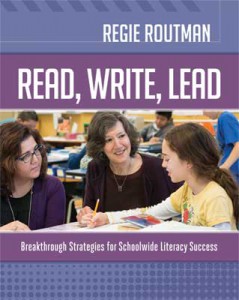
Regie Routman’s newest ASCD book, “Read, Write, Lead: Breakthrough Strategies for Schoolwide Literacy Success” was a cover to cover read for me. Knowing how well-respected Ms. Routman is certainly made me WANT to read this book, but the focus on literacy skills made it impossible to put down.
My top five take aways:
1. Establish a culture of trust. A level of professional trust is crucial for effective change. (In the same way the instructional leader needs to have a relationship with their staff in order to provide coaching support, a teacher must do the same with their students.) Where trust is missing, fear is often present, and fear is a guaranteed antidote to learning. The change when moving your campus/classroom to a literacy/writing based classroom will be different from what you are used too…keep those high expectations and keep moving forward.
2. Teach with urgency. Lacking the belief that we can positively influence the learning and achievement of ALL of our students will hold us back. Teach with a sense of relevancy and purpose & connect meaning to the tasks at hands.
3. These big ideas: modeled writing from instructors, student input, authentic book discussions, connect reading & writing. I’m going to look for strong teachers to help make these happen this year. Routman writes “We need to focus our reading and writing where our students’ interests are”. In an educational system where “student engagement” is crucial, there are quick wins shared that are practical and easy to implement, from kinder to high school.
4. The entire chapter on leadership priorities. “Effective leadership is essential for excellent school wide reading and writing practice across the curriculum”…and she cites a 6 year study that not one single successful school was able to be that way “with the absence of talented leadership”. The chapter highlights significant behaviors and actions of effective leaders, which led to accelerated achievement for both students and teachers.
5. Finally, the idea of PLCs: “professional literacy communities”…I don’t think there is too big a reach from the PLCs that we see working on campuses today to one with a literacy instructional focus. Allowing data to guide not dictate. Recognize that there is a difference between professional development and professional learning. Identify crucial questions that can be a school focus..and make sure you stay on track.
The appendix provides instructional look-fors that are also an incredible resource.
Want to get a copy for yourself?? You can order it here or you can also enter below to get a FREE copy! Enter between today (9/14/2014) and next Sunday, (9/21/2014) and I will send the winner their copy! (I’ll be keeping mine with all the high lighting, ;))
[gravityform id=”5″ name=”Read, Write, Lead”]
read on,
Amber


It’s time to get blogging! We’ve talked about the different do’s and don’ts for blogging…but I wanted to add a couple more here. Read through these and post a comment about the rule you think is MOST important and why.
For new teachers to our campus, there was a special breakfast. They were given a goodie bag, a campus tee-shirt & magnet, and an opportunity to meet with key members of our staff. Two of our veteran team members were there to talk them through what it means to be to a Watkins Wrangler. They shared the campus vision and the mission, as well as a glimpse into what it means to work here. One of our teacher leaders who opened the campus shared that before carpet was laid on the floor, the teachers were encouraged to come in and write what they wanted to see achieved on their cement classroom floor, or a scripture. Each room has a message written on the floor. Knowing that every room was so intentional in their student focus just warms my heart!
Finally, the first day of our teacher in service, each teacher was given a tee shirt, a welcome note, and a cookie for each of their students. Our teachers then used 


In a book that promises to lay out a plan that helps teachers close gaps in small group instruction, I found myself hoping that Ms, Rollins could do just that, knowing that my focus this school year would be p instructional strategies that truly makes a difference.