my version of transparent, collaborative leadership...with a Teamann twist

  • About
  • Speaking & Consulting
  • Books
  • Hear & See

Parents & your vision…

November 11, 2013 by Amber Leave a Comment

One of the challenges, regardless of your population, is figuring out a way to get all of your families involved at school. We sometimes have the mentality that the parents that we NEED to see are the ones we have a hard time reaching, but as Matt Gomez recently posted, we may need to step back and see what else we can do to make connections. I’ve seen three different ways that campuses have successfully built relationships within all types of families.

Recognizing cultures- Campuses that are able to celebrate the diversity of their building show their students and families that they value their history and past. Dr. Brown, our keynote speaker this year had a through provoking point about schools and their wheelbarrows. If some one looks at your wheelbarrow (all the people that you interact/work/develop ) and they don’t see anything that looks like “them”, they are going to have a hard time connecting with you. What kind of programs do you offer at your school/classroom? Is there diversity present? We had a multicultural night that our music teacher headed up that was incredible! Different families sponsored tables and provided background information about their culture. Some even handed out different food samples that represented their heritage. There were egg rolls, jerky, ravioli, and even apple pie! This free night really showed our families that we cared about the history and perspective they brought to our campus.

Meeting them where they are- Many of our parents have more than one child, and some are working more than one job. One of the great things about technology is that it can allow for no traditional communication to take place. Tools like twitter and remind101 allow teachers to send information through text messages for parents. These timely reminders can help keep parents informed and involved, regardless of whether or not they’ve had time to go through the weekly stack of papers that have come home. I chose to have different students record videos with our weekly goals and upcoming plans. I was strategic in who I chose to film some weeks, knowing that even there wasn’t a computer at home, if certain voices were present, parents would find a way to watch.

20131111-212741.jpg

Open door policy- Having a friendly, accommodating office staff is crucial. These faces are the flagship of your campus. The way parents, grand parents, and visitors are greeted will set the tone for their expectations while there. Smiles, helpful tones, and a “anything for you” attitude reassures them that we care about their most precious asset that they are leaving with us each day. As a mother, I would not feel comfortable leaving my girls at a place where I felt rebuffed, ignored, or chastised. I want to feel welcome and know that is how my girls would feel too. From start to finish, while they are in that front office, we should do our best to represent what our school stands for. It was a vey big deal for me for our front office to look like we worked in an elementary school…not a doctor’s office. Cold, clinical, sterile? No thank you! We added bright colors, encouraging messages, and most importantly, student work! The brag wall solicited many a compliment from our visitors. It also included frames that stated what each grade level would be learning about throughout the year. Parents walked out knowing that we were all about our students & learning.

November is parent engagement month. What are you doing to bring in your families?

Family friendly,
Amber

Filed Under: #SAVMP, Leadership, Parents

Lunch & Learn: a parent engagement opportunity!

November 10, 2013 by Amber Leave a Comment

Never under estimate a team of creative teachers who want to show off their creative students.  Our kinder team hosted a lunch and learn for their parents last week.  With November being a month of family engagement, this just tied right in!  After 30 minutes in classrooms, parents also got to enjoy lunch wit their child. Despite having packed classrooms and 22 five year olds, I was so impressed with the calm & collected manner in which our teachers worked the room, making sure each and every child had someone to share with.

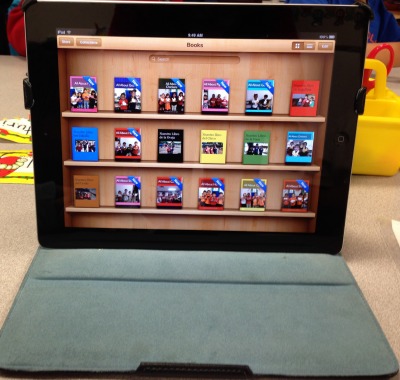
They sent home invites asking parents to come in for thirty minutes before their lunch time. As they walked in, their student greeted them with an iPad and they went and found somewhere to sit. Sharing a set of headphones, the student showed the parent how to get to the iBooks page. On that page, they were greeted by this, over a dozen student created iBooks showing off the culmination of their animal unit.

Photo Nov 08, 9 49 06 AM


After a field trip to the petting zoo, our kinder kiddos came back and created these iBooks. They took pictures and videos of their chosen animals in small groups. They came back and were asked different facts and fun questions by their teacher. It was all then compiled into a presentation that they were so proud to share. The beaming smiles on ALL of the faces reminded me that yes, school can be FUN, and accomplish its curricular goals. Students worked together, had tasks to complete, and had to learn facts about their chosen animal. Sounds like a typical kindergarten activity…but what made this different? The opportunity for their voice to be heard by their family. The opportunity to make an artifact that showcased their pictures and their videos in a format that excited them. Moms, dads, and even grandparents, got to share the excitement of pigs, sheep, and cows through a 5 year olds eyes.

A principal colleague recently asked if school should be fun. This day full of smiles and a much more authentic version of “what I learned on my field trip” reassures me that yes, yes it should.


engagement proud,

Amber


ps: That lunch and learn concept? Imagine the possibilities. PD. Any grade level can do it with parents. A google hangout with other administrators. A principal’s roundtable on any number of topics. Everyone likes food and a 30 minute commitment isn’t too much to ask…

Filed Under: Freebies, Parents, Staff Development Tagged With: #buckets, #parents, #pbl, #students, technology

Short on Time? an ASCD arias

November 2, 2013 by Amber 1 Comment

UntitledWhile preparing for my upcoming edWeb.net webinar, (which is free and open for registration!) “Become a PD Pro! Best Practices for Administrators” I decided to tackle a couple of books in my ever growing stack of  “must reads” I came across William Sterrett’s “Short on Time” and thought it seemed applicable. These new publications are GENIUS. (Now, I’ve only read this one, but I am hooked!) Why?

These Arias are billed as “providing concise answers to challenging questions that you need solved today”. I read it during one setting, just 40 pages, but it was chock full of information and the research to back up what it was offering. It wasn’t overrun with references and heavy facts, but VERY practical. It also referenced Lyn Hilt and Dwight Carter. There are some powerful tips from those two heavy hitters.

The book discussed time management, tackling your calendar, staff meetings, and communication. Each hot topic was explained, evaluated and then provided  a couple of excellent “management” tips. My favorite? When Mr. Sterritt discusses teacher growth he quotes Maya Angelou, ” I’ve learned that you can’t go through life with a catcher’s mitt on both hands, you need to be able to throw something back.”. We we have to be willing to catch (identify areas where we need to grow) and throw (share our strengths) with colleagues. As an administrator, I have to model this as well as build time for my teachers to be able to DO it.

I like this kinda book reading!


always short on time,

Amber


Filed Under: Leadership, Reading, Staff Development Tagged With: #admin, #beintentional #classroom, #cpchat

5 Key Strategies for ELL Instruction

October 30, 2013 by Amber Leave a Comment

5 Key Strategies for ELL Instruction

By Rebecca Greene

 (This article was orginally  published in an ASCD brief. Ms. Greene’s contributions have the voice of a teacher, which are powerful! )

English Language Learners (ELLs) face the double challenge of learning academic content as well as the language in which it is presented. Teachers have traditionally treated language learning as a process of imparting words and structures or rules to students, separate from the process of teaching content knowledge. This approach has left ELLs especially unprepared to work with the complex texts and the academic types of language that are required to engage in content area practices, such as solving word problems in Mathematics, or deconstructing an author’s reasoning and evidence in English Language Arts. ELLs need to be given frequent, extended opportunities to speak about content material and work through complex texts in English with small groups of classmates.

The new, widely-adopted Common Core State Standards and Next Generation Science Standards also call for all students, including ELLs, to master an array of academic language practices that are critical to achievement in content areas. Examples of these academic language practices include: argument from evidence, analysis of complex texts, and developing and using models. At Stanford’s Understanding Language, we have found that ELLs benefit from instructional approaches that treat language and content in an integrated way that is designed to help them build the language skills that they need to succeed in content classrooms, college and careers.


Working closely with Denver Public Schools teachers Ms. Emily Park-Friend (Bruce Randolph School) and Ms. Katie Langlois (Morey Middle School), we’re glad we can show through this video series ways that these 7th grade ELA teachers prepare their learners by activating prior knowledge, scaffolding meaning making with complex texts, and developing ELLs’ discipline and academic language practices in ELA classrooms.

ELL Lesson Overview

The set of six video clips begin with this short overview by Understanding Language ELA work group members George Bunch (University of California, Santa Cruz) and Aída Walqui (WestEd). This overview video discusses the key shifts found in the Common Core for ELLs and the opportunities for ELLs to grow their disciplinary knowledge and English language skills in heterogeneous classrooms. Through the classroom videos, we see several key strategies for encouraging English Language Development:

Scaffolding Understanding

The classroom video series highlight how ELA teachers can take account of the language demands that ELLs face in content classrooms and help ELLs meet these demands with increasing autonomy over time. As discussed in this video, this means providing ELLs with strategic types of scaffolding, such as graphic organizers, visual aids, peer help, or home language help, and removing these supports as students’ skills develop. This way, ELLs can be given the opportunity and the necessary support to meet rigorous academic standards.

Purposeful Grouping

Heterogeneous Classrooms

Also, as this video explains, ELLs learn best when they are in heterogeneous classrooms. ELLs need to be given ample opportunities to have extended interaction (such as doing ‘jigsaw’-type activities) with peers of varying English proficiency levels, who can provide ELLs with a range of models for how to use English words or structures appropriately, as well as abundant, personalized feedback on ELLs’ own developing English use. It is best for ELLs if, within their classrooms, teachers sometimes group students heterogeneously according to English proficiency, and sometimes homogeneously, depending on the purpose of the task at hand.

Background Knowledge

Another teaching technique (demonstrated here) that is beneficial for ELLs, is to provide them with relevant background knowledge about a topic to be discussed in class, or activate their existing knowledge of a topic. Besides increasing student interest, this allows students to focus more fully on the instructional goals, rather than being overwhelmed with too much new information at once. It also allows ELLs to bridge new knowledge to old knowledge, increasing understanding, and it helps some ELLs fill in contextual information (such as American political history or cultural details) that they may not have due to coming from different cultural backgrounds.

Extended Discussion

Extended Discussion

Though teachers have generally attempted to teach ELLs difficult vocabulary before having them read texts, ELLs learn new vocabulary best through extended discussion with their classmates after reading or between multiple readings, as this video explains.

Valuing Linguistic Differences

Schools and teachers can help ELLs greatly by learning about ELLs’ home cultures and languages, treating cultural and linguistic differences as resources rather than obstacles, and reaching out to students’ homes and communities to build learning opportunities together.

Here are more resources for teachers and administrators who are seeking to better support ELLs:

  • Understanding Language ELA and Mathematics resources
  • Understanding Language Key Principles for ELL Instruction
  • Framework for English Language Proficiency Development Standards corresponding to the Common Core State Standards and the Next Generation Science Standards

Rebecca Greene has a Ph.D. in Linguistics, specializing in Sociolinguistics, from Stanford University, and a Certificate in Teaching English as a Second Language from the University of Kentucky. She has extensive and varied experience as an instructor. Most recently she taught Language and Culture at California State University-East Bay. She has been working as a consultant with Understanding Language for two years. She also works as a Senior Research Assistant for Stanford University and for NORC at the University of Chicago.

Understanding Language aims to heighten educator awareness of the critical role that language plays in the new Common Core State Standards and Next Generation Science Standards, and to improve education for English Language Learners.

Filed Under: Uncategorized

How busy are you? #SAVMP

October 27, 2013 by Amber Leave a Comment

ku-mediumI wrote about managing time over on the School Admin Virtual Mentoring  Program blog this week and it really resonated with something a couple of assistant principals’ and I recently discussed.

We’re all working late and we’re all working hard. I think that’s just educators as a whole in this trying time of national pressure and low morale. How much of this pressure do we put on our self?  & is it even effective?

I’ll never forget a teacher I worked with a number of years ago. He stayed late every day. He came in early every day. He held his own extra sessions of Saturday school. I remember watching his students take their lunch trays down to his room each day and working through recess and thinking wow, this guy is SERIOUS.

When his test scores came back that year, imagine all of our surprise when only 1/4 of his class had met standard. How was that even possible??

Easy. Activity does not equal achievement.

If you’re constantly working and never seem to get caught up, or stay afloat, or feel like you’re drowning…maybe you should take a step back and re-evaluate what you’re doing. Spinning your wheels isn’t going to get you ahead. It’s actually only going to frustrate you even further.

If you don’t get your priorities in order, someone else will do it for you. If you fall behind in your lessons because of let’s say, an assembly, or some random computer based testing…don’t stress yourself out cramming everything in. Figure out what the TEKS of the lessons are and focus on those! Get the big picture across and don’t stress over whether you were to take grades on every suggested activity. At the end of the day, or er, grading period, that’s what matters. what the students were able to learn.

Think about all that you say you “have” to do…and before you stress out to the point of regretting your chosen path of impacting children each and every day…change those words to what you “choose” to do. You are the owner of your time.

Choose to have achievement, not just activity.

Choosingly,
Amber

<

Filed Under: #SAVMP Tagged With: #admin, #classroom, #cpchat, #edchat, #students, #teachers, #txed

  • « Previous Page
  • 1
  • …
  • 61
  • 62
  • 63
  • 64
  • 65
  • …
  • 92
  • Next Page »
  • Email
  • Instagram
  • LinkedIn
  • Pinterest
  • Twitter

Categories

Looking for something?

Featured Posts

What’s next: Leading with clarity and appreciation

For the past 25 years, I’ve had the opportunity to serve in public education in ways that have shaped me deeply as a … [Read More...]

Using AI like a leader, not a search engine

Hot take for 2026: If you’re frustrated with AI results, it’s probably not the tool. It’s the way we’re asking it to … [Read More...]

Archives

Topics

#admin #apps #ASCD #ascd13 #beintentional #beintentional #classroom #buckets #classroom #communication #cpchat #cpchat #txed #admin #edcampDallas #edchat #free #iste13 #LEADERSHIP #leadwithappreciation #parents #pbl #students #taketwo #teachers #thefirstyear #tichat #twitter #txed #vision #WMST amber teamann AmberTeamann Building Relationships digital citizenship educational leadership freebie Leadership Challenges Leadership Development leadership lessons learning from mistakes personal growth professional development Professional Growth social media Taylor Swift Taylor Swift Lyrics technology

Subscribe

Enter your email address to subscribe and I'll send you my social media and leadership starter kit as a thank you!

© 2026 · Technically Yours Teamann · Design by Albemarle PR